- Front Page
- Politica
- Local
- Internacional
- Deporte
- Analisis
- Investiga
- Live
- LenguahePapiamento

- Oduber ta rechasa sentencia y acusa sistema hudicial di “midi cu dos midi”
- Na Corsou SITEK a declara welga escolar pa exigi mas seguridad
- Yiu di Corsou asesina den tiroteo na Roermond, Hulanda
- Autor y poeta Jopi Hart a fayece na edad di 85 aña na Corsou
- Sondeo record ta descubri nuebe obheto nobo den lama di Aruba
- Oduber ta rechasa sentencia y acusa sistema hudicial di “midi cu dos midi”
- Na Corsou SITEK a declara welga escolar pa exigi mas seguridad
- Yiu di Corsou asesina den tiroteo na Roermond, Hulanda
- Autor y poeta Jopi Hart a fayece na edad di 85 aña na Corsou
- Sondeo record ta descubri nuebe obheto nobo den lama di Aruba
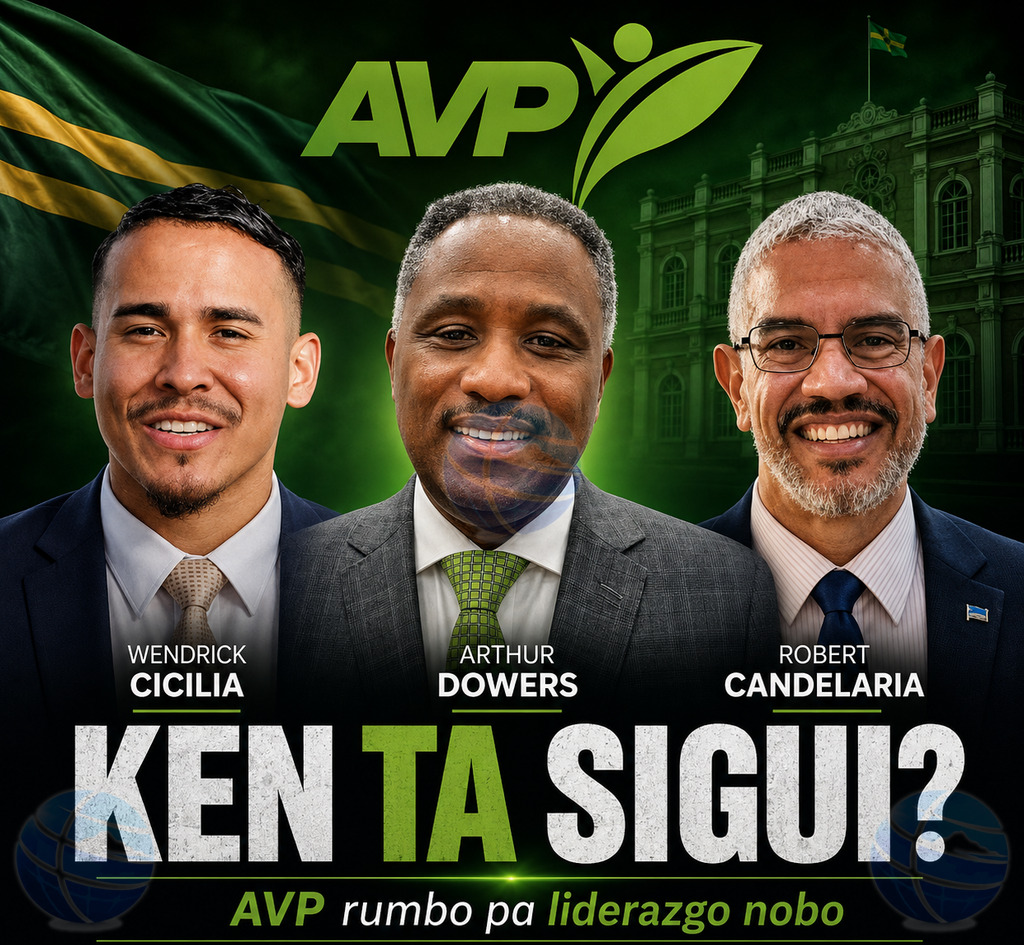
Cicilia, Dowers or Candelaria: race for AVP leadership continues
ORANJESTAD – With Mike Eman preparing to hand over the leadership of AVP in about three weeks, at the beginning of September, the question becoming increasingly relevant is: who will succeed him?
Among the names that may deserve attention are Wendrick Cicilia, Arthur Dowers and Robert Candelaria, although the latter has said he has no ambition for the position, while Dowers recently indicated that he has not yet decided whether he will put himself forward. None of that changes the fact that all three have strong ties to AVP, while representing three distinctly different political profiles. Eman announced in January that he intends to step down as party leader in September, after roughly 25 years at the helm of AVP. At the same time, Cicilia was publicly mentioned on Noticiacla LIVE as Eman’s preferred successor, although the final decision must go through the party’s internal process.
WENDRICK CICILIA: THE MOST OBVIOUS HEIR
On paper, Wendrick Cicilia has the strongest starting position. Cicilia obtained his Master of Laws degree from the University of Aruba in 2024. During the December 2024 election, as the number one candidate on the AVP list, he received 4,894 personal votes, more than any other AVP candidate. Arthur Dowers, by comparison, received 1,075. Following the formation of the AVP-FUTURO cabinet, Cicilia became Minister of Tourism, Transport and Labor. The portfolio placed an important part of the Aruban economy in his hands, including tourism, aviation, connectivity and the labor market. Over the past year, he has represented Aruba in meetings with the IMF, at the United Nations and in major projects related to the airport and international connectivity.
His strengths are clear: youth, electoral support, a ministerial position and the public backing of Mike Eman. But precisely that may also become his challenge. If Cicilia becomes leader, the question will be whether the public sees him as a leader with his own identity, or primarily as Eman’s chosen successor. Leading a major political party requires more than electoral popularity. It also requires the ability to keep different internal currents together and, eventually, carry the entire party into an election.
ARTHUR DOWERS: EXPERIENCE AND INSTITUTIONAL WEIGHT
Arthur Dowers represents the option of experience. He currently serves as Minister of Justice, Integration and Public Transport in the AVP-FUTURO cabinet. His political career goes considerably further back than Cicilia’s and includes previous experience as Minister of Justice. Dowers has a different profile: less a symbol of generational change and more a figure who knows government machinery, the party and ministerial responsibility In the 2024 election, he occupied the number three position on the AVP list and received 1,075 votes. That figure is considerably lower than Cicilia’s, but internal party leadership is not always determined by personal vote totals alone. Experience, internal relationships and the ability to unite different groups can also carry weight. If AVP wants a transition defined by continuity and experience, Dowers has a strong argument. His challenge is different: after 25 years of Mike Eman, the party may instead want to project renewal, and in that respect Cicilia naturally has an advantage.
ROBERT CANDELARIA: THE FACTOR THAT COULD CHANGE THE DYNAMIC
The third name is perhaps the most interesting precisely because he is currently not on AVP’s electoral front line. Robert Candelaria was an AVP parliamentarian and a member of the party board. In 2020, when Mike Eman was unable to participate in a summit of political leaders, AVP designated Candelaria to represent the party. That indicates that he enjoyed a significant level of trust within the organization at the time. But Candelaria has something the other two do not: an extensive career within the Aruba Police Force and criminal investigations. In 2024, the government was still identifying Candelaria as Commissioner and Head of the Criminal Investigation Service, and later as acting Chief Commissioner. His police experience was also a central part of his earlier political profile.
As a parliamentarian, Candelaria focused heavily on justice, crime, prevention and the functioning of the police apparatus. More recently, his profile has gained an academic dimension. In March 2026, an analysis based on a policy note prepared by Candelaria as part of his master’s studies at the University of Aruba addressed the issue of subversive crime and cooperation between Aruba and the Netherlands.
This potentially makes him a different kind of candidate: political experience combined with operational and institutional experience. But his weakness is equally clear. Candelaria was not a candidate on the AVP list in 2024 and therefore does not have a recent electoral mandate that can be directly compared with Cicilia or Dowers. A return to political leadership would require him to formally reconnect with the party’s active base. Candelaria himself is not seeking the position, according to information obtained by this news outlet. That does not change the fact that he remains an interesting potential candidate.
THREE OPTIONS, THREE DIRECTIONS
If these three names ultimately become part of a serious discussion, AVP would not simply be choosing between three individuals. The party would be choosing between three types of leadership. Cicilia represents a new generation and continuity with the transition Mike Eman appears to want. Dowers represents government experience and internal stability. Candelaria could represent the return of a figure who knows politics, but who has also accumulated substantial experience outside active politics, particularly in security and administration. Based on the public information currently available, Cicilia clearly starts as the favorite: he was number one electorally, received nearly 4,900 personal votes, is a minister and has Eman’s explicit backing. But an internal party election is not necessarily a national popularity contest. And that is precisely what makes the next phase interesting. After nearly a quarter of a century under Mike Eman’s leadership, the major question for AVP is not only who comes next.
The more important question is: what kind of AVP does the party want to emerge from the Mike Eman era?