- Front Page
- Politica
- Local
- Internacional
- Deporte
- Analisis
- Investiga
- Live
- LenguahePapiamento

- Aruba Real Estate Summit a pone foco riba desaroyo responsabel den sector inmobiliario
- Trahadornan di Arubus ta exigi fecha y solucion concreto pa salario
- Dos detencion mas den investigacion di tiramento na Mandolinstraat
- AHATA ta promove medidanan pa proteha trahadonan contra calor intenso
- Hulanda lo studia preclearance Europeo pa biahe entre Aruba y Europa
- Aruba Real Estate Summit a pone foco riba desaroyo responsabel den sector inmobiliario
- Trahadornan di Arubus ta exigi fecha y solucion concreto pa salario
- Dos detencion mas den investigacion di tiramento na Mandolinstraat
- AHATA ta promove medidanan pa proteha trahadonan contra calor intenso
- Hulanda lo studia preclearance Europeo pa biahe entre Aruba y Europa
Wever avoids backing Croes’ HOFA ultimatum and rejects predicting government collapse
ORANJESTAD – Finance Minister Geoffrey Wever has confirmed that the HOFA process forms part of the governing agreement between AVP and FUTURO, but during a pointed interview on Noticiacla LIVE, he repeatedly stopped short of endorsing the harder position recently expressed by his colleague Gerlien Croes: that if the coalition cannot agree on a fundamental part of its governing accord, there is effectively no government.
Journalist Tito Laclé pressed Wever several times for a clear answer: does he agree with Croes, yes or no? And if there is no agreement on HOFA, is that a breaking point for the coalition?
Wever confirmed that financial supervision and the negotiations with the Netherlands are part of the commitments AVP and FUTURO made when forming the government.
“What is part of the governing agreement, and what Minister Croes referred to, is that during the formation negotiations we discussed the RAFT/OFA issue.”
According to Wever, the process did not begin with the current AVP-FUTURO Cabinet. The government inherited negotiations already underway with the Netherlands, and both coalition parties agreed to continue that trajectory, including the objective of reducing Aruba’s interest burden on the national debt.
“So yes, the issue is part of the governing agreement, in the sense that Aruba and the Netherlands were already at an advanced stage of negotiations and those negotiations had to continue.”
Wever added that the current Cabinet continued working with the same expert commission already involved in the process and said the result now on the table is “considerably better” than what the government inherited.
But Laclé refused to leave the discussion at the technical level.
“My question is: do you agree with what your colleague, Minister Gerlien Croes, recently said?”
Wever confirmed the importance of governing agreements, but did not repeat Croes’ ultimatum.
“When we sign a governing agreement, we make certain agreements and commitments. That is the basis of a government.”
Croes has framed the issue in considerably more categorical terms, arguing that the governing agreement is the foundation of the coalition and that if partners cannot resolve a fundamental disagreement over what they agreed, the existence of the government itself comes into question.
Laclé therefore pressed again:
“But is this a break point for the coalition?”
Wever declined to say so.
“I cannot anticipate how parliamentarians will vote, nor what the final outcome of the negotiations will be. I do not want to anticipate that at this moment.”
The distinction is significant. Wever confirms that HOFA is part of the agreed direction of government, but he does not accept that disagreement automatically means the Cabinet must fall.
The minister also stressed that the process is not yet complete. Advice from the Council of Advice and the Kingdom Council of State has raised issues that still have to be addressed, while Aruba continues negotiations with the Netherlands before a final product can be submitted for parliamentary approval.
Laclé then sharpened the question further.
“If a member of Cabinet cannot support OFA, in your personal opinion can that person remain a minister?”
Wever initially answered from a constitutional perspective.
“Constitutionally, the Council of Ministers takes decisions by majority.”
Laclé pushed back.
“But I’m asking you personally. If that person is not pro-OFA and the government’s direction is OFA, do you believe that person can remain a minister?”
Wever acknowledged that signing a governing agreement creates obligations.
“When we sign a governing agreement, we make certain agreements and commitments. That is the basis of a government.”
At the same time, however, he argued that an individual minister may hold a different opinion, even on an important matter, as long as the Council of Ministers ultimately reaches a decision and the Cabinet presents itself publicly as a unit.
The discussion became even more concrete when Laclé raised Mike de Meza, who has publicly opposed HOFA and called for a referendum while his possible return to Cabinet has again become politically relevant.
Laclé asked:
“As Finance Minister and a key FUTURO figure, can you accept a fellow minister who publicly opposes such a fundamental financial part of the governing agreement?”
Wever replied:
“Ideally, you want every member of the Council of Ministers to be aligned with and in agreement with the governing agreement.”
He added that someone joining a government while strongly opposing a fundamental part of its agreed direction would naturally create “a difficult situation.”
Even then, however, Wever did not draw an absolute line.
The Noticiacla LIVE exchange therefore exposed a clear difference in political tone between two prominent FUTURO ministers. Croes has presented the governing agreement as a boundary that could determine the survival of the government. Wever confirms the HOFA commitment, but refuses to say that disagreement automatically means the coalition must collapse.
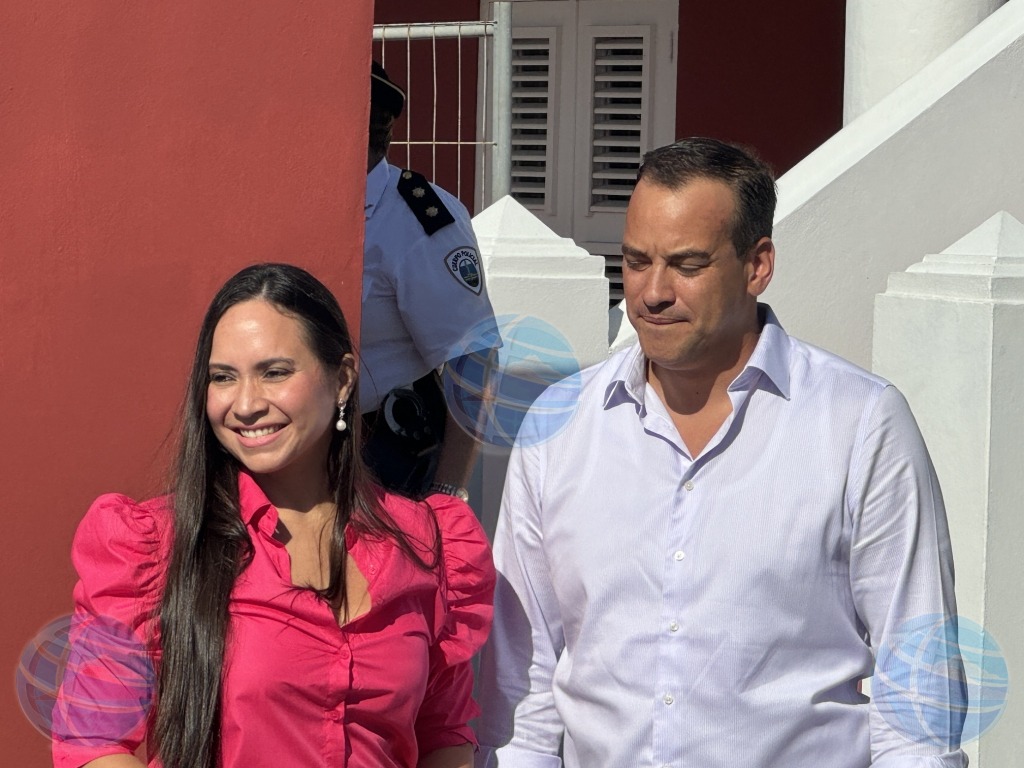
That leaves Laclé’s core question unresolved: if HOFA is truly a fundamental part of the governing agreement, how much room can a minister or coalition partner have to oppose it without putting the government itself at risk? Picture is noticiacla archive.