- Front Page
- Politica
- Local
- Internacional
- Deporte
- Analisis
- Investiga
- Live
- LenguahePapiamento

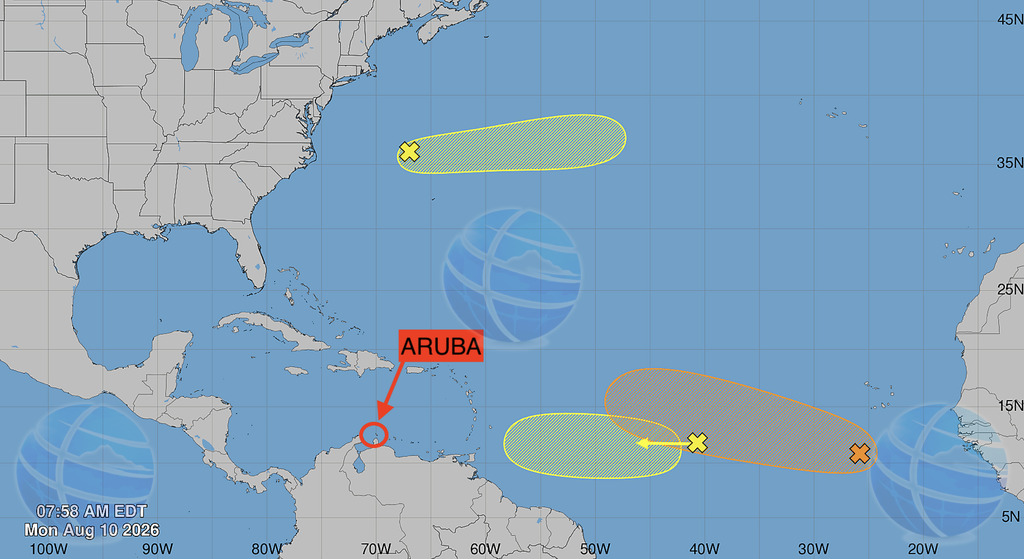
Two Atlantic systems under watch; no direct threat to Aruba
ORANJESTAD – Two areas of unsettled weather in the Atlantic are being closely watched as the hurricane season moves into a period when tropical activity normally begins to increase. There is currently no direct threat to Aruba, but both systems are relevant because they are moving generally westward toward the Caribbean.
The system drawing the most attention is located several hundred miles south of the Cabo Verde Islands, near Africa. It is currently producing scattered showers and thunderstorms, but conditions are expected to become more favorable for development during the coming days. The National Hurricane Center gives it a 20% chance of developing within 48 hours and a 60% chance within seven days. A tropical depression could form during the second half of this week as the system moves west to west-northwest across the Atlantic.
A second system is located roughly halfway between Africa and the Lesser Antilles. It is also moving westward, but its chances of significant development remain much lower at 10% through the next seven days. Conditions are expected to become less favorable as it approaches the Caribbean.
For Aruba, neither system currently has a defined path that would bring it directly toward the island. Both remain far away, and their eventual strength and direction can still change considerably.
Aruba lies south of the main Atlantic hurricane belt, making direct hurricane impacts relatively rare. However, Aruba's Meteorological Department notes that tropical systems passing nearby can still produce high seas, beach erosion, coastal flooding, rain and changes in wind conditions, even without a direct hit.
That makes the Cabo Verde system the more important one to watch in the coming days. If it develops and continues westward, forecasters will gradually get a clearer picture of whether any part of the Caribbean — including the southern Caribbean — could eventually be affected. At this stage, however, it is too early to suggest an impact on Aruba.
The activity comes shortly after NOAA lowered its expectations for the 2026 Atlantic hurricane season. In its August 6 update, NOAA raised the probability of a below-normal season to 75%, compared with 55% in its original May forecast.
NOAA now expects 7 to 13 named storms, including 2 to 6 hurricanes, with as many as 2 potentially becoming major hurricanes. Through August 9, the season had produced only two named storms, Arthur and Bertha, and no hurricanes.
A strengthening El Niño is one of the main reasons forecasters expect less Atlantic hurricane activity this year, because it tends to create conditions that make it more difficult for tropical systems to organize and strengthen.
A quieter forecast, however, does not eliminate the risk. The Atlantic hurricane season runs through November 30, and a single storm in the wrong place can have serious consequences regardless of how active the season is overall.
For Aruba, there is no reason for alarm at this point, but there is good reason to continue monitoring developments, particularly the system near the Cabo Verde Islands during the coming days.